
Let your word be yes, yes; no, no; for whatever is more than these comes from evil. » : An ethical-epistemic approach in the light of linguistic triangulation Transmission Referencing-Reception and its double
DOI:
https://doi.org/10.55595/a2aztm68Keywords:
Speech, Ethico-Epistemic, Emission, Reception, ReferencingAbstract
« The mouth speaks », « the eyes speak », « silence iself speaks », « your word is not reliable »…we hear it said daily. These linguistic manipulations around speech call for us to question what it is, what it is worth. We can even, in view of its diversity, establish a taxonomy according to the plurality of laws which are based on effects or objectives, or are their motives or incubators. However, speech ends up operating a centrifugation or a centripety which polarizes a double posture : « yes » as an indication of a positive speech, in a broad sense, which induces commitment, trust, truth ; and « no » as an indication of negative speech which fuels an anthitesis to the first posture ; allthis, in the light of an ethico-epistemologic evaluation.Downloads
References
Alario F-X., Dufour S., Chotiga P., « Codage lexico-sémantique : comment les mots font sens », pp.197-206, Pinto Serge, Sato Marc, Traité de neurolinguistique. Du cerveau au langage, Deboeck supérieur, 2016 DOI: https://doi.org/10.3917/dbu.pinto.2016.01.0197
Austin J. L., Quand dire, c’est faire, Paris, Editions du Seuil, 1970
Bourdieu P., Ce que parler veut dire : L’économie des échanges linguistiques, Paris, Fayard, 1982
Breton, P., La Parole manipulée, Grenoble, La Découverte (Cahiers Libres/Essais), 1997.
Gusdorf G., La Parole, Paris, PUF, col. « Quadriges », 1998
heidegger M., Acheminement vers la parole, Paris, Gallimard, col. Classiques de la philosophie, 1976
Legaut J., Les Lois de la parole : Conversation avec Camille, Paris, Erès, 2003
Morier H., Dictionnaire de poétique et de rhétorique, Paris, Presses Universitaires de France, 1989 (1961)
Nyckees V., La Sémantique, Paris, Belin, 1998
Reboul A., «The Description of Lies in Speech Acts Theory. » in Herman Parret, Pretending to Communicate, pp. 292-298, De Guyer, 1994 :
Volkof V., Petite Histoire de la désinformation : Du Cheval de Troie à Internet, Paris, Editions Du Rocher, 1999
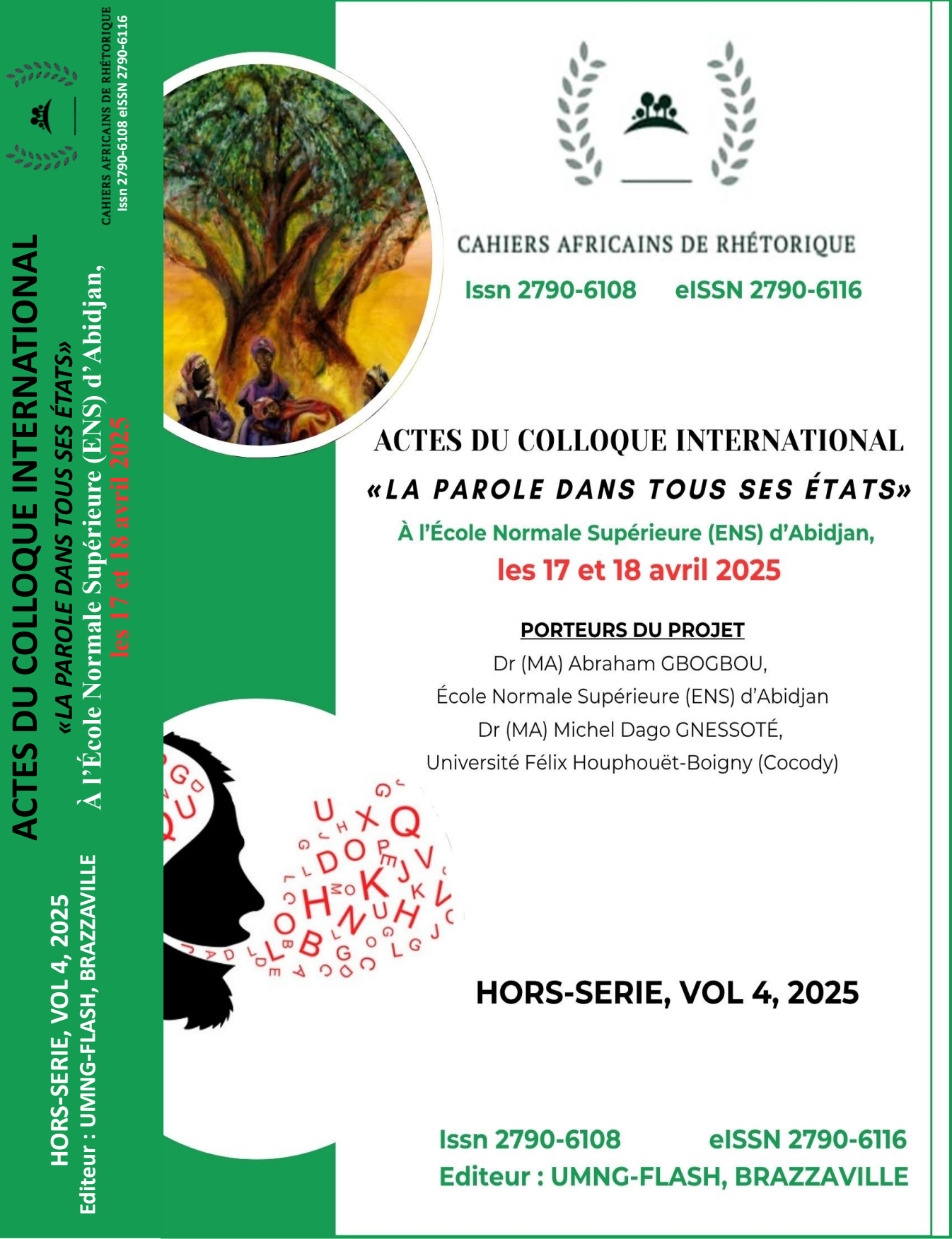
Downloads
Published
Data Availability Statement
Les données viennent des textes sacrés et les ouvrages des références biographiquesIssue
Section
License

This work is licensed under a Creative Commons Attribution-NonCommercial-NoDerivatives 4.0 International License.
Article licence: CC BY-NC-ND 4.0
Authors retain copyright and grant the journal the right of first publication. Articles carrying this licence may be copied and shared for noncommercial purposes, provided that the authors and journal are credited, copyright notices are retained and a link to the licence is supplied.
No distribution of adaptations: a translation, rewriting or other adapted version may not be distributed under this licence without separate permission from the rights holder. Statutory exceptions remain applicable.
Earlier versions: permissions already validly granted, including under CC BY-NC 4.0, remain in force. PDFs accompanied by the bilingual notice dated 3 October 2026 specify the licence of the distributed version and preserve the original pages as historical material.