À propos de cette revue
POLITIQUE ÉDITORIALE
-
Cahiers Africains de Rhétorique est une revue scientifique qui publie des recherches en analyse du discours, en linguistique, en stylistique, en littérature et en communication. À partir de 2026, elle publie des numéros thématiques. Elle applique le code d’éthique et de déontologie de la recherche en vigueur au sein du Conseil Africain et Malgache pour l’Enseignement Supérieur (CAMES).
La revue accueille des contributions de chercheurs du monde entier qui analysent les aspects linguistiques, rhétoriques et communicationnels de l’Afrique. Elle couvre les sciences du langage et leurs disciplines connexes :
- la linguistique ;
- la stylistique ;
- l’analyse du discours ;
- la littérature ;
- la communication.
Vocation et objectifs
La revue a pour vocation de publier des travaux de qualité, fondés sur des corpus oraux et textuels africains, en analyse du discours, en linguistique et en littérature. Elle se veut internationale et reçoit également des articles originaux issus d’autres aires géographiques, dès lors qu’ils relèvent de sa politique éditoriale.
Elle poursuit les objectifs suivants :
- faciliter l’accès des chercheurs de l’espace CAMES à une publication scientifique de qualité ;
- garantir une évaluation scientifique rigoureuse des travaux soumis, en écartant ceux qui ne répondent pas aux exigences de pertinence et de qualité ;
- publier les articles qui apportent une contribution significative et pertinente aux disciplines couvertes.
-
Libre accès et droits d’auteur
© Cahiers Africains de Rhétorique est une revue de l’Université Marien Ngouabi. Elle s’inscrit dans la politique du libre accès à l’information scientifique et technique : la politique éditoriale et les articles sont consultables en ligne, et toute commercialisation des articles est strictement interdite. Les articles doivent être cités conformément au Code de la propriété intellectuelle du CAMES.
En coopération scientifique avec les chercheurs des universités du CAMES, la revue se conforme à la Charte éthique, éditoriale et de confidentialité de cette organisation et à ses normes les plus strictes.
Responsabilité des auteurs et éthique
Les opinions exprimées dans les articles s’inscrivent dans le cadre du débat scientifique et engagent uniquement la responsabilité de leurs auteurs.
Conformément aux règles déontologiques et éthiques du CAMES en vigueur en matière de recherche, toute fraude scientifique sera signalée aux institutions universitaires et professionnelles de l’auteur. Sont notamment considérés comme fraude :
- le plagiat et l’auto-plagiat ;
- la soumission de textes générés artificiellement ;
- le retrait d’une proposition d’article sans notification préalable à la Rédaction.
Toute procédure non conforme entraîne le rejet automatique du texte et la cessation de la collaboration.
Numéro courant
Vol. 5 No 1 (2026): Les techniques rhétoriques du langage diplomatique
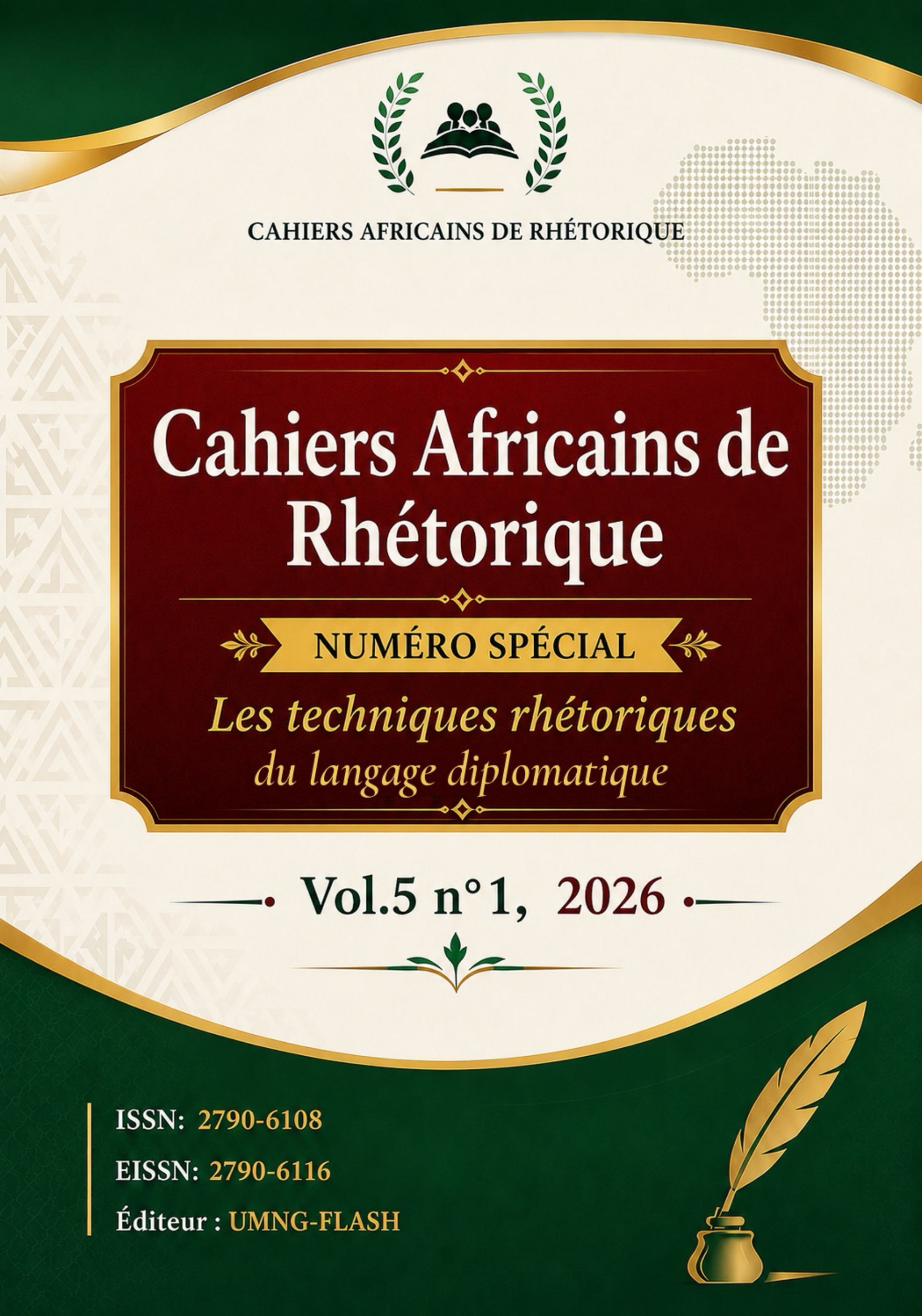
Ce numéro est consacré au langage diplomatique dans le monde.
Publiée:
2026-08-25
L'ensemble du numéro
Articles
Linguistique
Espace rédaction
Enregistrez les articles reçus par courriel et retrouvez leur suivi éditorial.
Une revue consacrée aux pratiques rhétoriques et discursives
Créés en 2022, les Cahiers Africains de Rhétorique sont une revue scientifique de la Faculté des Lettres, Arts et Sciences Humaines (FLASH) de l’Université Marien Ngouabi, à Brazzaville, en République du Congo. La revue publie deux numéros par an et accueille des articles en français et en anglais.
Son fil conducteur est l’étude des pratiques rhétoriques, argumentatives et discursives dans les langues, les littératures et les communications africaines, avec une ouverture aux comparaisons et aux contributions internationales. Elle examine comment le langage construit le sens, persuade, transmet des savoirs et participe aux représentations sociales.
Ses axes relient rhétorique et argumentation ; langues, stylistique et discours ; littératures et oralités ; communication et espaces publics. Les recherches sur des corpus locaux sont appréciées pour leur contribution théorique, méthodologique ou empirique, au-delà du seul contexte étudié.
Les manuscrits recevables font l’objet d’une évaluation en double aveugle. Les articles sont accessibles gratuitement, dans le respect de la licence propre à chaque publication.
Découvrir les axes scientifiques · Préparer un article · Comprendre l’évaluation