Paroles de djely : entre combattre l’oubli et honorer les héros mythiques chez les Mandingue
DOI :
https://doi.org/10.55595/tx35cj12Mots-clés :
Djely, Guerriers, Griot, Héros, Langue, Mandingue, Musique, Parole.Résumé
La société des hommes est régulée par un instrument majeur dénommé langue synonyme tantôt de langage ou tantôt de discours ou encore de parole. Cette dernière est l’apanage de l’humain qui s’en sert dans la quasi-totalité de ses activités. Cet instrument est, dans la communauté mandingue, d’une grande importance pour les djely ou griots. C’est dans cette logique qu’il faut comprendre les propos du griot Djely Mamadou Kouyaté, qui se prend pour maitre dans l’art de parler, ou encore les sacs à parole selon le texte de Niane (1960). Qui dit griot mandingue, dit forcément parole, discours au service non seulement des princes et des rois mais aussi et surtout au service du peuple. L’ensemble de ces considérations de cette contribution a montré le rôle vital de la parole dans la société mandingue. La pratique de la parole, du Verbe bien dit reste la vitrine de la culture et de la civilisation de ce peuple d’Afrique ; éléments fortement adossés au culte du discours surtout quand on parle de cette musique appelée janjon, hymne épique en l’honneur des guerriers.
TRANSLATE with x English Arabic Hebrew Polish Bulgarian Hindi Portuguese Catalan Hmong Daw Romanian Chinese Simplified Hungarian Russian Chinese Traditional Indonesian Slovak Czech Italian Slovenian Danish Japanese Spanish Dutch Klingon Swedish English Korean Thai Estonian Latvian Turkish Finnish Lithuanian Ukrainian French Malay Urdu German Maltese Vietnamese Greek Norwegian Welsh Haitian Creole Persian TRANSLATE with COPY THE URL BELOW Back EMBED THE SNIPPET BELOW IN YOUR SITE Enable collaborative features and customize widget: Bing Webmaster Portal BackRéférences
Calame G., 1965, Ethnologie et langage ? La parole chez les Dogon, Paris, Gallimard.
Camara S., Gens de la parole, Essai sur la condition et le rôle des griots dans la société Malinké, Pars, La Hayes, 1976 ; DOI: https://doi.org/10.1515/9783111639499
Cisse Y. T. et Kamissoko W., La grande geste du Mali des origines à la fondation de l’empire, Paris, Kharthala, 2000
Daynes S., « Frontières, sens, attribution symbolique : le cas du reggae », Cahiers d’ethnomusicologie [En ligne], 17 | 2004, mis en ligne le 13 janvier 2012, consulté le 19 avril 2019. URL : http://journals.openedition.org/ethnomusicologie/460 DOI: https://doi.org/10.2307/40240521
Diagne M., Critique de la raison orale. Les pratiques discursives en Afrique noire, Paris, Khartala, 2005)
Derive J., « La paarole » dans la culture mandingue., L’exemple des Dioula de Kong (Côte d’Ivoire) », Revue internationale d’anthropologie culturelle & sociale cArgo, 2012.
Fanny Y/, « La Symbolique de la faune et de la flore dans Soundjata ou l’épopée mandingue de Djibril Tamsir Niane », in Akofena ⎜Varian°12, Vol.7 ⎜CC BY 4.0.
Kesteloot L., Soundiata l'enfant-lion, Illustré par Joëlle Jolivet, Casterman, 1999 et 2010 pour la présente édition
Labatut R., 1987, « La parole à travers quelques proverbes peuls du Fouladou (Sénégal) », Journal des Africanistes, n°57, Fasc.1-2, pp.67-75. DOI: https://doi.org/10.3406/jafr.1987.2162
Manzon Agnieszka K., « Fortes paroles. Le pouvoir des mots en pays mandingue (et ailleurs) », Geneses 104, septembre 2016. DOI: https://doi.org/10.3917/gen.104.0030
Niane D. T., 1960, Soundjata ou l’épopée mandingue, Paris, Présence africaine.
Polo V., « Forme et texture polyphonique dans la musique des Wagogo de Tanzanie », Cahiers d’ethnomusicologie [En ligne], 17 | 2004, mis en ligne le 13 janvier 2012, consulté le 19 avril 2019. URL : http://journals.openedition.org/ethnomusicologie/416
Ranc E., « La parole dans le mariage malinké » In: Journal des africanistes, 1987, tome 57, fascicule 1-2. pp. 31-44 ; doi : https://doi.org/10.3406/jafr.1987.2160 https://www.persee.fr/doc/jafr_0399-0346_1987_num_57_1_2160 DOI: https://doi.org/10.3406/jafr.1987.2160
Roulon-Doko P., 1998, Chasse, cueillette et culture chez les Gbaya de Centrafrique, L’Harmattan, Paris, 540 pages
Saussure De Ferdinand, 1995, Cours de linguistique générale, Paris, Payot
Traore Amadou Z., « Soumangourou Kanté : héros déchu et/ou invisibilisé ? esquisse d’une autre lecture de sa vie et de ses œuvres », Akofena, Spécial n°8, Vol.1 – Juin 2022, pp. 3-15.
Trevor W. et J. H. Kwabena Nketia, « Gérer le passage de la tradition à la modernité », Cahiers d’ethnomusicologie [En ligne], 17 | 2004, mis en ligne le 13 janvier 2012, consulté le 01 mai 2019. URL :http://journals.openedition.org/ethnomusicologie/519
Zanetti V., « Le griot et le pouvoir », Cahiers d’ethnomusicologie [En ligne], 3 | 1990, mis en ligne le 15 octobre 2011, consulté le 10 décembre 2020. URL : http://journals.openedition.org/ethnomusicologie DOI: https://doi.org/10.2307/40240073
Zumthor P., 1983, Introduction à la poésie orale, Paris, Seuil
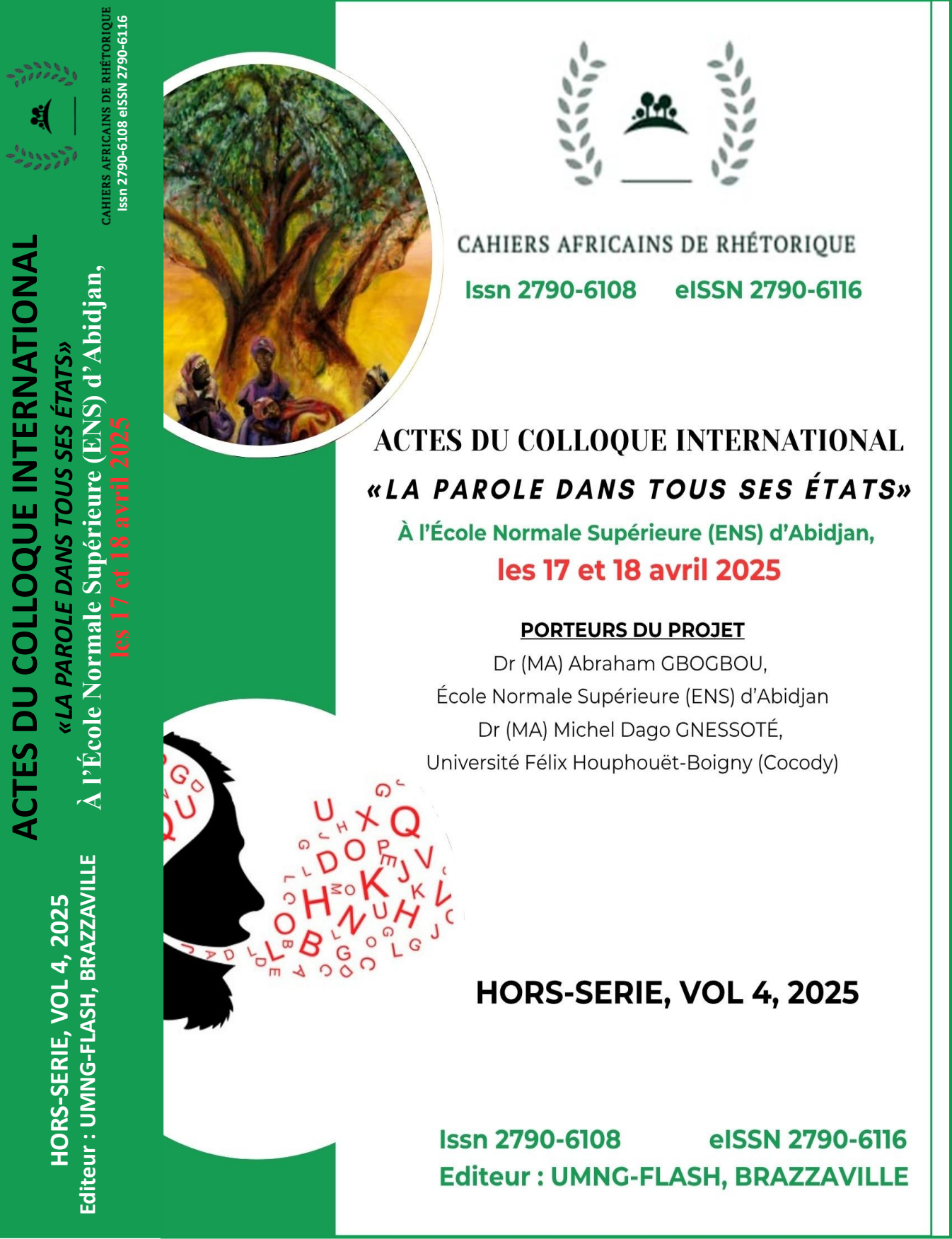
Téléchargements
Publiée
Déclaration de disponibilité des données
Mory K. : “ mory kanté/rail band - soundiata(l'exil )1975 ” https://www.youtube.com/watch?v=NEbKWn2OZ4w Mandekalou : http://chantshistoiremande.free.fr/Html/mandekalou2_disco.php Massa Makan D., Janjon et autres chants populaires du Mali, Paris, Présence Africaine, 1970, 110 p (M. M. DIABATÉ traduit fidèlement dans ce recueil les belles chansons des aèdes, dont il descend. Narena Moussa D. K., (Histoire de Mande Soundjata Keita) : https://youtu.be/uKB9Tb7GR1o?si=3FkT_0gXM1Is0qPa Touramaghan : https://youtu.be/tOO0_xB13QA?si=c6D-EfiOM7Cu8WP- https://youtu.be/gvSD7XBdVuE?si=6wB4GCNh2z1BXNDL Djely Bakoroba Diabaté https://youtu.be/Mi2ESa1VYgs?si=wXLCadfgWXa7cBpR Kesteloot Lilyan, Soundiata l'enfant-lion, Illustré par Joëlle Jolivet, Casterman, 1999 et 2010 pour la présente éditionNuméro
Rubrique
Licence

Ce travail est disponible sous licence Creative Commons Attribution - Pas d'Utilisation Commerciale - Pas de Modification 4.0 International.
Cahiers Africains de rhétorique © 2022 by UMNG is licensed under Creative Commons Attribution-NonCommercial-NoDerivatives 4.0 International


Les conditions de cette licence sont ainsi exposées: Les Cahiers Africains de Rhétorique appliquent la licence non commerciale CC BY-NC 4.0 "Creative Commons Attribution-Non Commercial 4.0 International". Selon cette licence, des droits d’auteur appartiennent au contributeur de l’article scientifique concerné. Ainsi, la présente licence permet aux éditeurs d’imprimer, de remixer, d’adapter et de construire sur le matériel dans n’importe quel support ou format, à des fins non commerciales seulement. Cependant, elle recommande que la propriété intellectuelle doive revenir à l’auteur de l’article. Dans cette perspective, le sigle NC signifie que seule l’utilisation non commerciale de l’œuvre est permise et qu’il n’est pas destiné à un avantage commercial ou à une compensation monétaire.